

Our task must be to free ourselves… by widening our circle of compassion to embrace all living creatures and the whole of nature in its beauty.

Our task must be to free ourselves… by widening our circle of compassion to embrace all living creatures and the whole of nature in its beauty.
Albert Einstein

Widening Our Circle of Compassion
Topic: Love, Compassion, & Kindness
A human being is part of the whole, called by us ‘universe,’ a part limited in time and space. He experiences himself, his thoughts and feelings, as something separate from the rest—a kind of optical delusion of consciousness. This delusion is a kind of prison for us, restricting us to our personal desires and to affection for a few persons nearest to us. Our task must be to free ourselves from this prison by widening our circle of compassion to embrace all living creatures and the whole of nature in its beauty.
Albert Einstein, born on 14 March 1879 and passing away on 18 April 1955, stands as one of the most renowned theoretical physicists in history. Best known for his groundbreaking special and general theories of relativity, his scientific endeavors spanned a multitude of areas within the field of physics. Amongst his numerous accolades, he was awarded the Nobel Prize in physics for his elucidation of the photoelectric effect—a phenomenon that expanded the horizons of quantum theory.
Einstein's journey, however, wasn't merely defined by scientific discoveries, but by the myriad challenges he overcame across various dimensions of his life. In his spiritual journey, he grappled with the concepts of God and universe. Socially, he navigated the complexities of his time—facing the rise of anti-Semitism, experiencing exile from his homeland due to Nazi oppression, and advocating for civil rights, disarmament, and global peace. These adversities only strengthened his resolve and underscored his resilience.
Beyond his professional accomplishments, Einstein's life was enriched by a tapestry of relationships and dialogues with luminaries from diverse fields. He engaged in profound conversations on the nature of reality with the likes of the Indian poet Rabindranath Tagore, discussed the principles of non-violence with Mohandas Gandhi, and deliberated on humanitarian issues with Albert Schweitzer. Furthermore, his camaraderie with fellow scientists and physicists provided a fertile ground for intellectual exchanges, fostering an environment of collaboration and innovation during one of the most exciting epochs in scientific history.
Levy, Naomi. Einstein and the Rabbi: Searching for the Soul. Flatiron Books, Macmillan, 2018 [Naomi Levy, Einstein and the Rabbi: Searching for the Soul] pp. 22-23.
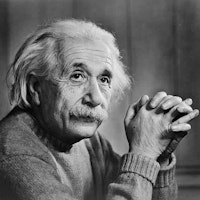
Albert Einstein
Theme: Compassion
About This Albert Einstein Quotation [Commentary]
Albert Einstein begins with a basic fact of belonging: “A human being is part of the whole, called by us ‘universe,’” though “a part limited in time and space.” Yet we experience our “thoughts and feelings” as “something separate from the rest.” Albert Einstein calls this separation “a kind of optical delusion of consciousness.” It becomes “a kind of prison,” restricting us to “our personal desires” and to “a few persons nearest to us.”
Albert Einstein then names the work before us: “Our task must be to free ourselves from this prison.” We do this “by widening our circle of compassion.” As the sense of separateness loosens, our concern can move beyond what is personal and familiar. Compassion becomes a widening of the circle, a way of living less confined by the “optical delusion” that we exist apart from the whole.
Albert Einstein carries this widening outward “to embrace all living creatures and the whole of nature in its beauty.” His words move from our place within the “whole,” through the prison of separateness, toward a larger belonging. To “free ourselves” is to let our care reach beyond the few nearest to us and include the living world of which we are already a part.
Rabbi Naomi Levy’s Commentary
Rabbi Naomi Levy frames “the mission of Einstein’s true religion” as a practice that “strive[s] to free us from the optical delusion of our consciousness that we are separate, when in truth we are one,” adding, “never before in human history do we need this message more.” She immediately turns that truth into a way of living: “To believe it, to know that we belong to each other,” because “we’re all part of a great wholeness, all things, the living and yes, even the dead,” and “it’s our delusion of separateness that causes us so much pain when in reality all is connected and intertwined.” To take it “a tiny bit deeper,” she cites Albert Einstein’s condolence note after Michele Besso died: “the distinction between past, present, and future is only a stubbornly persistent illusion,” and then lets her closing line carry the whole point with a steady warmth: “If that’s the mission of true religion I would love to be a rabbi in that religion.”
Resources
Related Quotes
Copyright © 2017 – 2026 LuminaryQuotes.com About Us