

When the soul is totally lost, it finds that it is the very Self which it sought for so long in vain. Here the soul Is God.

When the soul is totally lost, it finds that it is the very Self which it sought for so long in vain. Here the soul Is God.
Meister Eckhart

The Very Self
Topic: Self-Cultivation & Health
When the soul is totally lost, it finds that it is the very Self which it sought for so long in vain. Here the soul Is God. Here it enjoys supreme bliss; here it is sufficient unto itself; here it shines with its own radiance. Here at last it has found that the Kingdom of God is itself!
Meister Eckhart, whose full name was Eckhart von Hochheim OP, (c. 1260 – c. 1328) was born around the year 1260, possibly between 1250 and 1260, in the village of Tambach, near Gotha, in the Landgraviate of Thuringia, which is now central Germany, within the Holy Roman Empire. The prefix "Meister" in his name translates to "Master," signifying his scholarly prestige. His birth into nobility was initially purported, however, later examinations revealed that this notion stemmed from a misinterpretation of period archives, clarifying that his Christian name was Eckhart, with the surname von Hochheim.
Eckhart commenced his ecclesiastical journey around the age of 18, circa 1278, by joining the Dominican convent at Erfurt. His scholarly pursuits possibly led him to study at Cologne before 1280, and perhaps also at the University of Paris either before or after his time in Cologne. His commitment to the Dominican order was substantial, as he entered the order when he was 15 and later, around 1294, began his teaching career as a lecturer on the Sentences of Peter Lombard at the Dominican convent of St. Jacques in Paris.
Meister Eckhart's theological and philosophical endeavors were deeply rooted in mysticism, with a notable emphasis on the union between the individual soul and God, as expressed in his sermons both in German and Latin. His rising prominence was particularly noted during the Avignon Papacy, a period marked by increased tensions among monastic orders and diocesan clergy. Unfortunately, the latter part of his life was marred by accusations of heresy, leading to a trial by the local Franciscan-led Inquisition, and subsequently by Pope John XXII. Despite these challenges, Eckhart's teachings continued to resonate through his disciples like Johannes Tauler and Henry Suso, and his mystic philosophy continues to garner attention and appreciation in contemporary religious and academic circles.
Star, Jonathan. Two Suns Rising: A Collection of Sacred Writings. Edison, New Jersey, Castle Books, 1996, p. (p. 160). [Eckhart, Meister. “When the soul is totally lost, it finds that it is the very Self which it sought for so long in vain. Here the soul Is God.” Meister Eckhart, the Essential Sermons, Commentaries, Treatises, and Defense, New York: Paulist Press, 1981.
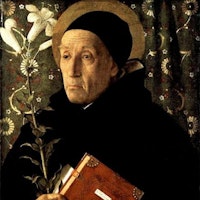
Meister Eckhart
Theme: Being in Self
About This Meister Eckhart Quotation [Commentary]
Meister Eckhart reveals a central truth of the spiritual journey: “When the soul is totally lost, it finds that it is the very Self which it sought for so long in vain.” This seeming paradox points to the surrender of the separate self, with its attachments, desires, and need for control. What is lost is not the soul’s true nature, but the limited sense of identity that obscures it. In letting go, the soul discovers what it has been seeking all along. Meister Eckhart expresses this union with the divine in the words, “Here the soul Is God.” The journey toward the true Self is not about acquiring something new, but awakening to the divine presence already within.
Meister Eckhart deepens this understanding by inviting the soul to let go of its separate identity and enter the “bottomless sea of the Godhead.” In this surrender, the soul discovers its unity with God. Here, as Meister Eckhart writes, the soul “enjoys supreme bliss; here it is sufficient unto itself; here it shines with its own radiance.” These words describe an inner fullness that no longer depends on outward circumstances or the search for fulfillment. The soul finds its sufficiency in the divine life at its deepest center.
The theme of Being in Self finds its fullest expression in Meister Eckhart’s concluding words: “Here at last it has found that the Kingdom of God is itself!” What the soul once sought beyond itself is discovered within, where seeking God gives way to knowing God directly. The soul’s “supreme bliss” and “own radiance” arise not from self-importance, but from freedom from the separate self. Being in Self, in this deeper sense, is a state of surrender, inner freedom, and conscious unity with the divine. Meister Eckhart reminds us that the Kingdom of God is not a distant promise, but a living reality discovered when the soul releases what conceals its true nature.
Meister Eckhart—Eknath Easwaran
Devotion to a divine incarnation—Jesus, Sri Krishna, the Buddha, the Divine Mother—helps greatly, for it gives us a focus for our love outside the narrow compass of our self-will. The subtlety is that this divine focus is not outside us. The Lord is our real Self, embodying the divine qualities which all of us have within us.
It follows that when we are looking for the Lord, unifying our desires to realize him, the Lord is looking for us at the same time. Meister Eckhart, the towering mystic of Medieval Germany, goes even further: the eye with which you see God, he says, is the same eye with which God is looking all the time at you… We don’t realize that He can open the door to deeper consciousness from inside; yet silently, subtly, all the time we are banging away on the door, He is undoing the latch on the other side. This is what devotion to a spiritual ideal can do.
—Eknath Easwaran [Conquest of the Mind] pp. 148 – 149.
Meister Eckhart—Annetta Maguire
In her chapter on Meister Eckhart, Maguire (2013) explains that Eckhart was a most significant figure in the history of Christian Mysticism. Born in Thuringia in Germany in 1260 he is believed to have belonged to a family of the lower aristocracy. Eckhart entered the Dominican Priory at the monastery in Erfurt at the age of fifteen.
Few details of his personal life are known to us. Unlike Christian mystics such as Julian of Norwich, St Teresa of Avila and St John of the Cross, he did not speak of himself or his own spiritual experiences. What is known of him and his theology is largely gleaned from his sermons. As was the case with other members of the Dominican Order, he stressed the importance of preaching. Consequently, Eckhart’s focus was on those to whom he preached and their experiences rather than his own. As his reputation grew large numbers of people came to hear his sermons.
As revealed by the quotations in the Anthology included in this essay, the non-duality, transcendence and immanence of Divinity was an inherent aspect of his theology. According to Maguire (2013):
Maguire also stated:
*Source: Maguire, Annetta. (2013). Praying with Christian Mystics. County Dublin, The Columba Press. [Cited in Mysticism, the Perennial Philosophy and Interfaith Dialogue by Philip Brown.]
Resources
Related Quotes
Copyright © 2017 – 2026 LuminaryQuotes.com About Us