

Sticking with that uncertainty, getting the knack of relaxing in the midst of chaos, learning not to panic—this is the spiritual path.

Sticking with that uncertainty, getting the knack of relaxing in the midst of chaos, learning not to panic—this is the spiritual path.
Pema Chödrön

The Spiritual Path
Topic: Spiritual Growth & Practice
Life is a good teacher and a good friend. Things are always in transition, if we could only realize it. Nothing ever sums itself up in the way that we like to dream about. The off-center, in-between state is an ideal situation, a situation in which we don’t get caught and we can open our hearts and minds beyond limit. It’s a very tender, nonaggressive, open-ended state of affairs.
To stay with that shakiness—to stay with a broken heart, with a rumbling stomach, with the feeling of hopelessness and wanting to get revenge—that is the path of true awakening. Sticking with that uncertainty, getting the knack of relaxing in the midst of chaos, learning not to panic—this is the spiritual path. Getting the knack of catching ourselves, of gently and compassionately catching ourselves, is the path of the warrior. We catch ourselves one zillion times as once again, whether we like it or not, we harden into resentment, bitterness, righteous indignation—harden in any way, even into a sense of relief, a sense of inspiration.
Pema Chödrön, born Deirdre Blomfield-Brown on July 14, 1936, in New York City, grew up on a farm in New Jersey. She attended Miss Porter's School before earning a degree in English literature from Sarah Lawrence College and a master’s in elementary education from the University of California, Berkeley. She married at 21 and had two children before experiencing two divorces. Her spiritual journey led her to study Buddhism with Lama Chime Rinpoche in London and Chögyam Trungpa Rinpoche in the United States. In 1974, she was ordained as a novice nun by the Sixteenth Gyalwa Karmapa, Rangjung Rigpe Dorje, and in 1981, became the first American woman fully ordained in the Vajrayana tradition.
Chödrön played a key role in bringing Tibetan Buddhism to the West. In the early 1980s, Trungpa Rinpoche appointed her director of the Boulder Shambhala Center in Colorado. She later moved to Gampo Abbey in Nova Scotia, the first Tibetan Buddhist monastery in North America for Western students, becoming its director in 1986. Recognized as an acharya (senior teacher) in 1993, she continued teaching despite health challenges, including chronic fatigue syndrome. Her books, such as When Things Fall Apart (1996) and No Time to Lose (2005), explore resilience, mindfulness, and compassion, emphasizing shenpa, the habitual grasping that leads to suffering.
In 2020, Chödrön retired from her role as acharya within Shambhala International, citing concerns over the organization’s direction. She continues to teach, lead retreats, and study with her teacher, Dzigar Kongtrul Rinpoche. Recognized for her contributions to Buddhist practice, she received the Global Bhikkhuni Award in 2016. Though she stepped back from institutional leadership, she remains a guiding voice in contemporary Buddhism, emphasizing the power of mindfulness and compassion in daily life.
When Things Fall Apart
Chödrön, Pema. When Things Fall Apart: Heart Advice for Difficult Times. Shambhala Publications, 1997, P. 10.
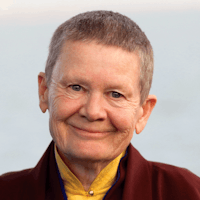
Pema Chödrön
Theme: Spiritual Growth
About This Pema Chödrön Quotation [Commentary]
Pema Chödrön places the spiritual path in the midst of ordinary human uncertainty. “Things are always in transition,” she says, and nothing “sums itself up in the way that we like to dream about.” In that light, the “off-center, in-between state” is not a failure to get life settled. It is “an ideal situation,” because there we do not get caught and can “open our hearts and minds beyond limit.” Spiritual growth begins here: not in control or conclusion, but in a “tender, nonaggressive, open-ended state of affairs.”
Pema Chödrön then names the practice with great plainness: “to stay with that shakiness—to stay with a broken heart, with a rumbling stomach, with the feeling of hopelessness and wanting to get revenge.” This is the setting for her central insight: “Sticking with that uncertainty, getting the knack of relaxing in the midst of chaos, learning not to panic—this is the spiritual path.” She does not call us away from pain, fear, or confusion. She calls us to remain, to stay present, and not to panic. Spiritual growth, in her words, is less about escaping difficulty than about learning how to be with it.
She goes on to call this “the path of the warrior,” and the heart of that path is “gently and compassionately catching ourselves.” We do this “one zillion times” as we harden into “resentment, bitterness, righteous indignation,” or harden “in any way.” Her emphasis is steady and practical. We notice the hardening, and we return. We catch ourselves with compassion, again and again. In this way, spiritual growth is not a finished state. It is the repeated willingness to stay open in the very place where we would rather close.
Additional Pema Chödrön Quotations
“To be fully alive, fully human, and completely awake is to be continually thrown out of the nest. To live fully is to be always in no-man’s-land, to experience each moment as completely new and fresh.”
—Chödrön, Pema. When Things Fall Apart: Heart Advice for Difficult Times. Shambhala Publications, 1997.
“The essence of bravery is being without self-deception.”
—Chödrön, Pema. The Pocket Pema Chödrön. Shambhala Publications, 2008.
“When we protect ourselves so we won’t feel pain, that protection becomes like armor, like armor that imprisons the softness of the heart.”
—Chödrön, Pema. The Places That Scare You: A Guide to Fearlessness in Difficult Times. Shambhala Publications, 2001.
“Compassion is not a relationship between the healer and the wounded. It’s a relationship between equals.”
—Chödrön, Pema. The Places That Scare You: A Guide to Fearlessness in Difficult Times. Shambhala Publications, 2001.
“Nothing ever goes away until it has taught us what we need to know.”
—Chödrön, Pema. The Pocket Pema Chödrön. Shambhala Publications, 2008.
“Fear is a natural reaction to moving closer to the truth.”
—Chödrön, Pema. When Things Fall Apart: Heart Advice for Difficult Times. Shambhala Publications, 1997.
“The future is completely open, and we are writing it moment to moment.”
—Chödrön, Pema. The Pocket Pema Chödrön. Shambhala Publications, 2008.
Related Quotes
Copyright © 2017 – 2026 LuminaryQuotes.com About Us