

To forgive is to create the possibility of a new beginning, not just for the individual, but for the entire human family.
Coretta Scott King


To Forgive Is
Topic: Virtue, Morality, & Ethics
The greatness of a community is most accurately measured by the compassionate actions of its members, a heart of grace, and a soul generated by love. We must learn to forgive, for a spirit of revenge will only perpetuate the cycle of violence. To forgive is to create the possibility of a new beginning, not just for the individual, but for the entire human family.
Coretta Scott King (née Scott) was born on April 27, 1927, in Heiberger, Alabama, United States, the third of four children to Obadiah Scott and Bernice McMurry Scott. Raised in the rural South during the Great Depression, she worked alongside her family to sustain their farm while pursuing an education her parents insisted was essential. Valedictorian of Lincoln Normal School, she attended Antioch College in Ohio on scholarship before transferring to the New England Conservatory of Music in Boston, where she earned a degree in voice and piano. It was there she met Martin Luther King Jr., and the two married on June 18, 1953. Moving to Montgomery, Alabama, she quickly found herself in the midst of the civil rights struggle, using her musical gifts in concerts that blended artistry with advocacy.
Following the assassination of her husband in 1968, Coretta Scott King assumed a visible leadership role in the ongoing fight for racial justice. She founded the Martin Luther King Jr. Center for Nonviolent Social Change in Atlanta, working to preserve his legacy and advance the principles of nonviolent activism. Her efforts were instrumental in the campaign to establish Martin Luther King Jr. Day as a U.S. federal holiday, signed into law in 1983. Beyond civil rights, she expanded her advocacy to include women’s rights, opposition to apartheid in South Africa, and support for LGBTQ rights. She maintained relationships with national leaders, including presidents and members of Congress, using her influence to address both domestic and global human rights issues.
In later years, Coretta Scott King continued to speak, write, and participate in movements for justice and peace worldwide. She was recognized with honors such as the Gandhi Peace Prize and induction into both the Alabama Women’s Hall of Fame and the National Women’s Hall of Fame. On January 30, 2006, she died in Rosarito, Baja California, Mexico, at the age of 78, from complications of ovarian cancer. She was the first African American to lie in state at the Georgia State Capitol, and she was buried beside her husband at the King Center. Throughout her life, she articulated a vision of the “Beloved Community,” where conflicts are resolved peacefully and justice forms the foundation for lasting harmony—a vision that continues to influence movements for equality today.
King, Coretta Scott. My Life, My Love, My Legacy. Edited by Rev. Dr. Barbara Reynolds, Henry Holt and Co., 2017.
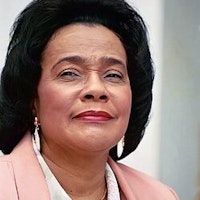
Coretta Scott King
Theme: Forgiving
About This Coretta Scott King Quotation [Commentary]
Coretta Scott King begins with a clear standard: “The greatness of a community is most accurately measured by the compassionate actions of its members.” She links those actions to “a heart of grace” and “a soul generated by love.” Greatness, in her words, is not a claim a community makes about itself; it is what people do, and the spirit they bring to what they do.
She then turns to what blocks that greatness: “We must learn to forgive, for a spirit of revenge will only perpetuate the cycle of violence.” Revenge keeps the harm moving. Forgiving interrupts what “perpetuate[s]” violence and makes room for compassion and grace to guide how we respond, even when the injury is real.
From there, Coretta Scott King names what Forgiving opens: “To forgive is to create the possibility of a new beginning, not just for the individual, but for the entire human family.” A “new beginning” is more than personal relief; it reaches outward. When forgiveness replaces revenge, the “human family” gains a chance to live from love rather than remain bound to the cycle of violence.
Coretta Scott King’s philosophy of forgiveness
Coretta Scott King’s philosophy of forgiveness was inextricably linked to her commitment to Agape—a proactive, redemptive, and disinterested love. For her, forgiveness was not a passive acceptance of injustice, but a powerful tool for social and personal transformation.
Here are four additional quotations from her primary writings and speeches that reflect this understanding:
1. The Power of “Unearned Suffering”Following the assassination of her husband, King spoke frequently about the “redemptive power” of suffering when met with a forgiving heart, a core tenet of the nonviolent movement.
2. Forgiveness and the Beloved Community. King viewed forgiveness as the “interpersonal work” required to build the “Beloved Community.” This passage emphasizes that forgiveness is a continuous duty.
3. Nonviolence as the Expression of Love. In this context, King explains that nonviolence is the outward behavior of an inward state of forgiveness. It is the “highest form” of love applied to conflict.
4. Breaking the Chain of Hate. This quote emphasizes the “holistic integration” of thought and behavior. She argues that holding onto bitterness is a form of self-imprisonment.
Related Quotes
Copyright © 2017 – 2026 LuminaryQuotes.com About Us