

God has built the human form into the world structure, indeed even the cosmos… Humankind is called to co-create.
Hildegard of Bingen


Called to Co-Create
Topic: The Natural World
God has built the human form into the world structure, indeed even the cosmos, just as an artist would use a particular pattern in her work. God be praised in his handiwork: Humankind. Humankind is called to co-create.
Hildegard of Bingen (1098-1179) was a Benedictine abbess and mystic of medieval Germany. She was born into a noble family in Bermersheim vor der Höhe, Germany, and entered religious life at the age of eight. She received a rudimentary education, but at the age of forty-two, she began to experience a series of visions that would shape her life and work.
Hildegard described these visions as "the living light," and they were often accompanied by physical sensations such as heat, cold, and pain. She believed that these visions were a gift from God, and she felt called to share them with the world. She began to write down her visions, and she also composed music and poetry to express her spiritual insights.
Hildegard was a prolific writer, and her works cover a wide range of topics, including theology, natural science, medicine, and music. She is best known for her three volumes of visionary theology: Scivias, Liber Vitae Meritorum, and Liber Divinorum Operum. These works are rich in symbolism and imagery, and they offer a unique perspective on the nature of God, the human soul, and the world.
In addition to her writings, Hildegard was also a gifted musician and composer. She wrote over 70 songs, including the Ordo Virtutum, an early example of liturgical drama. Her music is characterized by its simple melodies and its use of plainchant.
Hildegard was a complex and multifaceted figure, and her work continues to inspire and challenge people today. She was a visionary, a mystic, a writer, a composer, a scientist, and a healer. She was also a woman of great courage and determination, and she used her gifts to make a difference in the world.
Hildegard of Bingen was a remarkable woman who left a lasting legacy. She was a pioneer in the fields of theology, natural science, and music, and her work continues to be studied and appreciated today. She was also a powerful voice for women's rights, and she challenged the patriarchal structures of her time. Hildegard of Bingen was a true visionary, and she continues to inspire us with her courage, her intellect, and her creativity.
Scivias
Fox, Matthew, editor. Illuminations of Hildegard of Bingen. Bear & Company, 2003.
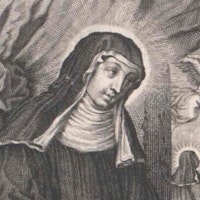
Hildegard of Bingen
Theme: Beauty
About This Hildegard of Bingen Quotation [Commentary]
Hildegard of Bingen writes, “God has built the human form into the world structure, indeed even the cosmos.” Her words locate humanity not on the edge of creation, but within its very framework. The human form is not incidental—it is part of the design, placed there with care. Hildegard continues, “just as an artist would use a particular pattern in her work,” affirming that the structure of the cosmos includes a recognizable shape: the human form. This image invites reverence not only for the vastness of creation but for the human presence within it, patterned and intentional.
She writes next, “God be praised in his handiwork: Humankind.” In this line, the praise of God is linked directly to the recognition of humanity as part of divine creation. Hildegard does not separate the Creator from the created; rather, she names humankind as “his handiwork.” The beauty here is not surface-level, but rests in the fact of being made—integrated into the structure of the world and the wider cosmos. This view reshapes how we understand the human role—not as isolated individuals, but as beings placed intentionally within a greater order, one worthy of reverence and care.
Hildegard concludes, “Humankind is called to co-create.” The call follows naturally from the earlier vision: if humanity is built into the cosmos with the care of an artist, then it is also invited to participate in that ongoing work. To co-create is not to dominate but to join in. Beauty, in this light, is not a possession but a shared action—something that arises when human life aligns with the pattern already present. For Hildegard, this is not abstract: it is an invitation to live in response to the structure we are already part of, with a sense of responsibility, humility, and praise.
Richard Rohr, Hildegard of Bingen, Scivias [Excerpted from his commentary]
Throughout the ages, the mystics have kept alive the awareness of our union with God and thus with everything. What some now call creation spirituality, deep salvation, or the holistic Gospel was voiced long ago by the Desert Fathers and Mothers, some Eastern Fathers, in the spirituality of the ancient Celts, by many of the Rhineland mystics, and surely by Francis of Assisi. Many women mystics were not even noticed, I am sorry to say.
Julian of Norwich (c. 1343-c. 1416) and Hildegard of Bingen (1098-1179) would be two major exceptions (though even they have often been overlooked).
Hildegard of Bingen communicated creation spirituality through music, art, poetry, medicine, gardening, and reflections on nature. She wrote in her famous book, Scivias: “You understand so little of what is around you because you do not use what is within you.” This is key to understanding Hildegard and is very similar to Teresa of Ávila’s view of the soul. Without using the word, Hildegard recognized that the human person is a microcosm with a natural affinity for or resonance with the macrocosm, which many of us would call God. Our little world reflects the big world. The key word here is resonance. Contemplative prayer allows your mind to resonate with what is visible and right in front of you.
—Adapted from Richard Rohr with John Feister, Hope Against Darkness: The Transforming Vision of Saint Francis in an Age of Anxiety (Franciscan Media:2001), 135; and unpublished “Rhine” talks (2015) [the Center for Action and Contemplation].
Matthew Fox, Hildegard of Bingen, Scivias
Hildegard entitles her reflections on Vision Six “On Human Nature.” Yet one can see readily that she has much more in mind than humanity in this vision—she has the cosmos in mind and she offers a “close-up” of the human (microcosm) cosmic (macrocosmi relationship. The human body, for Hildegard, is in the cosmos and the cosmos is in the human body. One forms the other. “Now God has built the human form into the world structure, indeed even the cosmos, just as an artist would use a particular pattern in his or her work. God be praised in his handiwork: Humankind. Humankind is called to co-create.
Hildegard von Bingen’s vision of the Feminine Divine
Additional Hildegard of Bingen Quotes
Resources
Related Quotes
Copyright © 2017 – 2026 LuminaryQuotes.com About Us