


If you cut people off from what nourishes them spiritually and historically, something within them dies.
Jacqueline Bouvier Kennedy

Nourishes People Spiritually
Topic: The Natural World
If you cut people off from what nourishes them spiritually and historically, something within them dies.
Jacqueline Bouvier Kennedy was born on July 28, 1929, in Southampton, New York, to John Vernou Bouvier III and Janet Lee Bouvier. Raised in a privileged yet turbulent household, she developed a love for literature, art, and equestrian sports. She studied at Vassar College before transferring to George Washington University, earning a degree in French literature in 1951. After graduation, she worked as a journalist for the Washington Times-Herald before meeting John F. Kennedy, then a U.S. senator. They married in 1953, and she soon took on the role of political partner, supporting his successful 1960 presidential campaign. At 31, she became First Lady, bringing attention to the arts, historic preservation, and diplomacy, notably overseeing the White House restoration and promoting American culture abroad.
As First Lady, Jacqueline Kennedy became an influential figure, admired for her intelligence, grace, and commitment to public service. Fluent in multiple languages, she played a key role in diplomatic visits, earning international admiration. She worked to preserve American heritage, establishing the White House Historical Association and advocating for historic landmarks. She also navigated moments of crisis, including the Cuban Missile Crisis. On November 22, 1963, she was at her husband’s side when he was assassinated in Dallas. In the aftermath, she orchestrated a funeral rich in historical symbolism and worked to shape John F. Kennedy’s legacy.
In 1968, Jacqueline Kennedy married Greek shipping magnate Aristotle Onassis, seeking privacy and security for herself and her children. After his death in 1975, she built a career as a book editor in New York City, working at Viking Press and later Doubleday. She remained engaged in historic preservation, playing a role in saving Grand Central Terminal. In her later years, she led a private life while continuing to support cultural and political causes. She died from cancer on May 19, 1994, at age 64, and was buried at Arlington National Cemetery alongside President Kennedy. She remains one of the most recognizable First Ladies, remembered for her contributions to American culture and history.
Onassis, Jacqueline Kennedy. Quoted in Bill Adler, The Eloquent Jacqueline Kennedy Onassis: A Portrait in Her Own Words. William Morrow, 2004.
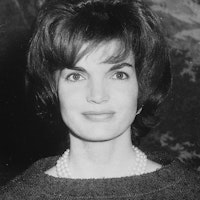
Jacqueline Bouvier Kennedy
Theme: Beauty
About This Jacqueline Bouvier Kennedy Quotation [Commentary]
Jacqueline Bouvier Kennedy writes with plain cause and effect: “If you cut people off” from “what nourishes them spiritually,” then “something in them dies.” In the fuller line—“what nourishes them spiritually and historically”—she keeps “spiritually” and “historically” together, as if inner life and shared memory belong together. What nourishes can be prayer and reflection, but also the stories, symbols, and places that help people know who they are. When people are “cut…off” from that nourishment, the loss reaches “something within them,” not just an opinion or a preference.
She spoke the same way when she defended Grand Central Terminal: “Is it not cruel to let our city die by degrees, stripped of all her proud monuments, until there will be nothing left of all her history and beauty to inspire our children?” Here “history and beauty” are not luxuries; they “inspire.” She presses the point further: “If they are not inspired by the past of our city, where will they find the strength to fight for her future?” Taken with “what nourishes them spiritually and historically,” her words suggest that removing “history and beauty” can weaken a city’s inner life, and the inner life of its children.
Jacqueline Bouvier Kennedy also resisted treating the White House as mere display: “It would be a sacrilege merely to ‘redecorate’ it—a word I hate. It must be restored—and that has nothing to do with decoration. That is a question of scholarship.” “Restored” and “scholarship” name a kind of care that keeps people connected to what nourishes them. In that light, Beauty belongs with “what nourishes…spiritually and historically”—not as surface polish, but as something that can “inspire,” give “strength,” and keep “something within” from dying.
More about Jacqueline Bouvier Kennedy’s Love of Beauty
Jacqueline Bouvier Kennedy’s sentence—“If you cut people off from what nourishes them spiritually and historically, something within them dies”—belongs with the standard she set for the White House: “Everything in the White House must have a reason for being there.” She would not call that work “redecorate”—“a word I hate”—because “It must be restored—and that has nothing to do with decoration. That is a question of scholarship.” And she kept the purpose practical and human: visitors should encounter things “that develop” a living “sense of history,” and they should also feel how a place can be “beautiful and lived-in”—how “a fire in the fireplace and pretty flowers” can make a house seem cared for. Her defense of Grand Central carries the same logic into the city itself: “Is it not cruel to let our city die by degrees… until there will be nothing left of all her history and beauty to inspire our children?” and then, “If they are not inspired by the past of our city, where will they find the strength to fight for her future?” Taken together, her own words keep returning to one clear thread: when people are denied what “nourishes” them—through lost memory, lost places, and lost Beauty—“something within them dies,” and when they are given “history and beauty” that can “inspire,” they find “strength” to carry a future.
Additional Jacqueline Bouvier Kennedy Quotations
Related Quotes
Copyright © 2017 – 2026 LuminaryQuotes.com About Us