


Compassion becomes real when we recognize our shared humanity.
Pema Chödrön

Compassion Becomes Real
Topic: Love, Compassion, & Kindness
In cultivating compassion we draw from the wholeness of our experience—our suffering, our empathy, as well as our cruelty and terror. It has to be this way. Compassion is not a relationship between the healer and the wounded. It’s a relationship between equals. Only when we know our own darkness well can we be present with the darkness of others. Compassion becomes real when we recognize our shared humanity.
Pema Chödrön, born Deirdre Blomfield-Brown on July 14, 1936, in New York City, grew up on a farm in New Jersey. She attended Miss Porter's School before earning a degree in English literature from Sarah Lawrence College and a master’s in elementary education from the University of California, Berkeley. She married at 21 and had two children before experiencing two divorces. Her spiritual journey led her to study Buddhism with Lama Chime Rinpoche in London and Chögyam Trungpa Rinpoche in the United States. In 1974, she was ordained as a novice nun by the Sixteenth Gyalwa Karmapa, Rangjung Rigpe Dorje, and in 1981, became the first American woman fully ordained in the Vajrayana tradition.
Chödrön played a key role in bringing Tibetan Buddhism to the West. In the early 1980s, Trungpa Rinpoche appointed her director of the Boulder Shambhala Center in Colorado. She later moved to Gampo Abbey in Nova Scotia, the first Tibetan Buddhist monastery in North America for Western students, becoming its director in 1986. Recognized as an acharya (senior teacher) in 1993, she continued teaching despite health challenges, including chronic fatigue syndrome. Her books, such as When Things Fall Apart (1996) and No Time to Lose (2005), explore resilience, mindfulness, and compassion, emphasizing shenpa, the habitual grasping that leads to suffering.
In 2020, Chödrön retired from her role as acharya within Shambhala International, citing concerns over the organization’s direction. She continues to teach, lead retreats, and study with her teacher, Dzigar Kongtrul Rinpoche. Recognized for her contributions to Buddhist practice, she received the Global Bhikkhuni Award in 2016. Though she stepped back from institutional leadership, she remains a guiding voice in contemporary Buddhism, emphasizing the power of mindfulness and compassion in daily life.
Chödrön, Pema. The Places That Scare You: A Guide to Fear and Its Transformation. Shambhala Publications, 2001. P. 50. "Compassion."
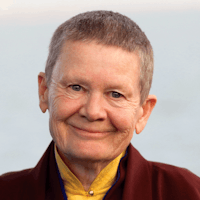
Pema Chödrön
Theme: Compassion
About Pema Chödrön’s Quote [Commentary]
Pema Chödrön redefines compassion as “a relationship between equals,” not a dynamic of healer and wounded. This shift begins with a clear-eyed acknowledgment of our own inner life. “Only when we know our own darkness well can we be present with the darkness of others.” Compassion is not distant or elevated; it is grounded in shared experience. Recognizing this common ground allows us to meet others not from a place of fixing or saving, but from a place of understanding.
To cultivate compassion, Pema Chödrön says we must draw “from the wholeness of our experience—our suffering, our empathy, as well as our cruelty and terror.” She does not separate the admirable from the difficult. Compassion includes all of it. Our own pain and failures are not barriers but necessary openings. In facing them, we become more able to remain present with what others carry, without recoiling or closing down.
“Compassion becomes real when we recognize our shared humanity.” It is not sentimental or removed. It becomes real when we see ourselves in one another—when we stop dividing the world into those who suffer and those who help. In that recognition, compassion is no longer a gesture. It becomes a way of being—honest, inclusive, and rooted in the truth that we are all in this together.
The Four Limitless Ones Chant
In her teaching on the Four Limitless Ones—the qualities of loving‑kindness, compassion, joy, and equanimity—Pema Chödrön presents the chant as a foundational Buddhist aspiration practice. She explains that these four limitless qualities are capacities already present in the heart that can be nurtured and deepened through dedicated practice. In the Four Limitless Ones practice, we work with the aspiration for well‑being and freedom for ourselves and others. Chödrön emphasizes a step‑by‑step cultivation of these qualities: we begin by expressing heartfelt aspirations for those close to us, and then extend those same wishes outward to all beings. In doing so, we “express our willingness to open our hearts” and develop the ability to sustain an open, unbiased heart toward all sentient beings. The practice is not about affirming what we lack but about training the heart to “go beyond our fear of feeling pain” so we can expand these aspirations universally.
Below is the chant she teaches, traditionally used in this practice:
—Chödrön, Pema. Perfect Just as You Are: Buddhist Practices on the Four Limitless Ones: Loving‑Kindness, Compassion, Joy, and Equanimity. Shambhala Audio, 2009.
Resources
Related Quotes
Copyright © 2017 – 2026 LuminaryQuotes.com About Us