

With a deeper understanding of reality, you can go beyond appearances and relate to the world in a much more appropriate, effective, and realistic manner.

With a deeper understanding of reality, you can go beyond appearances and relate to the world in a much more appropriate, effective, and realistic manner.
The Dalai Lama

A Deeper Understanding
Topic: Wisdom & Understanding
Much of traditional Buddhist practice is directed toward the ability to see life accurately, beyond all the expectations, projections, and distortions that we typically bring to it. Meditative practice allows us to quiet the distracting thoughts and feelings so that we can perceive reality, and respond to it more skillfully. The ability to be present in each moment is nothing more and nothing less than the ability to accept the vulnerability, discomfort, and anxiety of everyday life.
“With a deeper understanding of reality,” the Dalai Lama has explained, “you can go beyond appearances and relate to the world in a much more appropriate, effective, and realistic manner.”
Tenzin Gyatso, born on July 6, 1935, is known globally as the 14th Dalai Lama, the spiritual and former political leader of the Tibetan people. Born as Lhamo Thondup in a farming family in Taktser, Amdo, Tibet, he was recognized as the reincarnation of the 13th Dalai Lama, Thubten Gyatso, when he was just two years old. As the Dalai Lama, he holds the highest spiritual position within Tibetan Buddhism and is seen as a figure of great moral authority and influence. Following China's invasion of Tibet in 1950, he assumed full political power in 1950 but was forced into exile in India in 1959 after the failed Tibetan uprising against Chinese rule.
The Dalai Lama is renowned for his messages of peace, non-violence, inter-religious understanding, and compassion. He has authored numerous books and has lectured worldwide, becoming one of the most influential figures in the world of spirituality and philosophy. In recognition of his work for peace and non-violence, he was awarded the Nobel Peace Prize in 1989. Furthermore, his advocacy for the cultural and religious rights of the Tibetan people and his efforts to find a peaceful solution to the situation in Tibet through dialogue and understanding, rather than violence, have made him an internationally respected leader. Despite the political controversies and challenges, he remains committed to promoting human values and harmony among the world's religious traditions.
The Book of Joy
The Dalai Lama, and Desmond Tutu. The Book of Joy: Lasting Happiness in a Changing World. Edited by Douglas Carlton Abrams, Viking, 2016, pp. 223-228.
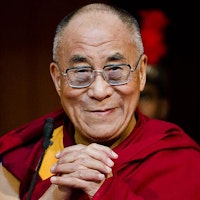
The Dalai Lama
Theme: Understanding
About the Dalai Lama’s Quote [Commentary]
The Dalai Lama’s words point to a central movement of Wisdom: learning to see “beyond appearances.” Much of our suffering begins when we mistake our expectations, projections, and distortions for reality itself. Meditative practice helps quiet the distracting thoughts and feelings that keep us caught on the surface. As the Dalai Lama teaches, “with a deeper understanding of reality,” we can begin to see life more accurately, not as we fear it to be or demand it to be, but as it is.
This “deeper understanding of reality” does not ask us to step away from life. It asks us to meet “the vulnerability, discomfort, and anxiety of everyday life” with steadier attention. Acceptance is not passivity or defeat. It is the honest recognition of what is happening, so our response can be clearer and more skillful. When we are less ruled by judgment, anxiety, or despair, we can “go beyond appearances” and relate to people, problems, and uncertainty with greater patience and compassion.
The Dalai Lama connects inner clarity with practical action. To “relate to the world in a much more appropriate, effective, and realistic manner” means that understanding changes how we live. We learn to face what can be changed, accept what cannot, and notice when the mind is adding unnecessary fear or resistance. In this way, Wisdom becomes a disciplined way of seeing and responding, opening space for peace of mind, kindness, and a more truthful relationship with life.
Commentary by Douglas Carlton Abrams—The Dalai Lama’s Deeper Understanding
When we had visited the Tibetan Children’s Village in January, we noticed a wall displaying a quote that the Dalai Lama referenced in the dialogues. It was a translation of Shantideva’s famous questions that His Holiness had mentioned, only in a slightly different translation: “Why be unhappy about something if it can be remedied? And what is the use of being unhappy if it cannot be remedied?” In this short teaching is the profound essence of the Dalai Lama’s approach to life…
Much of traditional Buddhist practice is directed toward the ability to see life accurately, beyond all the expectations, projections, and distortions that we typically bring to it. Meditative practice allows us to quiet the distracting thoughts and feelings so that we can perceive reality, and respond to it more skillfully. The ability to be present in each moment is nothing more and nothing less than the ability to accept the vulnerability, discomfort, and anxiety of everyday life.
“With a deeper understanding of reality,” the Dalai Lama has explained, “you can go beyond appearances and relate to the world in a much more appropriate, effective, and realistic manner. I often give the example of how we should relate to our neighbors. Imagine that you are living next to a difficult neighbor. You can judge and criticize them. You can live in anxiety and despair that you will never have a good relationship with them. You can deny the problem or pretend that you do not have a difficult relationship with your neighbor. None of these is very helpful.
Instead, you can accept that your relationship with your neighbor is difficult and that you would like to improve it. You may or may not succeed, but all you can do is try. You cannot control your neighbor, but you do have some control over your thoughts and feelings. Instead of anger, instead of hatred, instead of fear, you can cultivate compassion for them, you can cultivate kindness toward them, you can cultivate warmheartedness toward them. This is the only chance to improve the relationship. In time, maybe they will become less difficult. Maybe not. This you cannot control, but you will have your peace of mind. You will be able to be joyful and happy whether your neighbor becomes less difficult or not.”
We come back to the beginning of our discussion and Shantideva’s questions. The kind of acceptance that the Dalai Lama and the Archbishop were advocating is not passive. It is powerful. It does not deny the importance of taking life seriously and working hard to change what needs changing, to redeem what needs redemption. “You must not hate those who do harmful things,” the Dalai Lama has explained. “The compassionate thing is to do what you can to stop them for they are harming themselves as well as those who suffer from their actions.”
—The Dalai Lama, and Desmond Tutu. The Book of Joy: Lasting Happiness in a Changing World. Edited by Douglas Carlton Abrams, Viking, 2016, pp. 223, 226-227.
Related Quotes
Copyright © 2017 – 2026 LuminaryQuotes.com About Us