

Grandparents, parents, children and God – the center of them all is true love…. The three-generation family is like the entire universe. It is like a textbook to learn how to love the universe.

Grandparents, parents, children and God – the center of them all is true love…. The three-generation family is like the entire universe. It is like a textbook to learn how to love the universe.
Sun Myung Moon

The Three-Generation Family
Topic: Family & Friendship
“As children you are destined to inherit the fortune of your grandparents and parents. Why do you need grandparents? They represent the past–they embody the living history of the past. Parents represent the present age and children represent the future. Thus, the family connects the past, present and future, as well as East, West, North and South. Grandparents, parents, children and God–the center of them all is true love. Think about whether it is this way in your family. By loving and respecting your grandfather and grandmother, you inherit everything from the past and learn from the past. From your father and mother you learn about the present. By loving and cherishing your children, you learn about the future… The three-generation family is like the entire universe. It is like a textbook to learn how to love the universe.“
Sun Myung Moon (born January 6, 1920, in Jeongju, in what is now North Korea – died September 3, 2012, in Gapyeong, South Korea) was a Korean religious leader, entrepreneur, and founder of the Unification movement. Raised in a rural Confucian-Christian household during the Japanese occupation of Korea, Moon’s early life was shaped by hardship, devotion, and a strong sense of spiritual calling. As a teenager, he experienced a profound vision in which he believed Jesus commissioned him to complete the work of restoring humanity to unity with God. This revelation became the foundation of his lifelong ministry, devoted to the ideal of universal peace and the healing of the relationship between the divine and human families.
In 1954, after enduring persecution and periods of imprisonment under both Japanese and communist authorities, Moon founded the Holy Spirit Association for the Unification of World Christianity in Seoul. His teachings—later presented systematically in the Exposition of the Divine Principle—offered a reinterpretation of Christian theology emphasizing God’s parental love, human responsibility, and the sanctity of marriage and family. Central to his vision was the belief that love is the creative force of the universe and that humanity’s purpose is to build a world reflecting the oneness of God’s heart. Through international missions, interfaith dialogue, and mass wedding ceremonies symbolizing global reconciliation, Moon sought to transcend divisions of race, religion, and nationality.
Beyond his religious work, Moon established numerous organizations in education, media, culture, and humanitarian service, aiming to foster dialogue, moral renewal, and peace. He and his wife, Hak Ja Han Moon, were regarded by followers as the “True Parents,” embodying the ideal of restored unity between men and women, heaven and earth. While his movement inspired both devoted commitment and significant controversy, Moon’s influence on global religion, culture, and peace initiatives remains substantial. His life reflected an unwavering pursuit of the vision of one human family under God—a vision he advanced with conviction, discipline, and enduring faith in the transformative power of divine love.
Wilson, Andrew, editor. World Scripture II. Universal Peace Federation, 2011, p. 974 [Sun Myung Moon (162:140, April 5, 1987)].
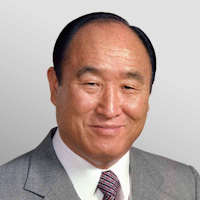
Sun Myung Moon
Copyright © 2017 – 2026 LuminaryQuotes.com About Us
Additional Sun Myung Moon Quotes
“God’s love abides where parents, husband and wife, and children are united in love. Where these three kinds of love come together, God dwells absolutely and for eternity. This family is God’s dwelling-place. Wherever there is unchanging parental love, unchanging conjugal love, and unchanging children’s love, God is always present.”
–Sun Myung Moon [(131:112, April 22, 1984) World Scripture II] p. 927