

Meditation is about seeing clearly… with precision and gentleness.
Pema Chödrön


Seeing Clearly
Theme: Meditation
Meditation is about seeing clearly the body that we have, the mind that we have, the domestic situation that we have, the job that we have, and the people who are in our lives. It’s about seeing how we react to all these things. It’s seeing our emotions and thoughts just as they are right now, in this very moment, in this very room, on this very seat. It’s about not trying to make them go away, not trying to become better than we are, but just seeing clearly with precision and gentleness.
Pema Chödrön, born Deirdre Blomfield-Brown on July 14, 1936, in New York City, grew up on a farm in New Jersey. She attended Miss Porter's School before earning a degree in English literature from Sarah Lawrence College and a master’s in elementary education from the University of California, Berkeley. She married at 21 and had two children before experiencing two divorces. Her spiritual journey led her to study Buddhism with Lama Chime Rinpoche in London and Chögyam Trungpa Rinpoche in the United States. In 1974, she was ordained as a novice nun by the Sixteenth Gyalwa Karmapa, Rangjung Rigpe Dorje, and in 1981, became the first American woman fully ordained in the Vajrayana tradition.
Chödrön played a key role in bringing Tibetan Buddhism to the West. In the early 1980s, Trungpa Rinpoche appointed her director of the Boulder Shambhala Center in Colorado. She later moved to Gampo Abbey in Nova Scotia, the first Tibetan Buddhist monastery in North America for Western students, becoming its director in 1986. Recognized as an acharya (senior teacher) in 1993, she continued teaching despite health challenges, including chronic fatigue syndrome. Her books, such as When Things Fall Apart (1996) and No Time to Lose (2005), explore resilience, mindfulness, and compassion, emphasizing shenpa, the habitual grasping that leads to suffering.
In 2020, Chödrön retired from her role as acharya within Shambhala International, citing concerns over the organization’s direction. She continues to teach, lead retreats, and study with her teacher, Dzigar Kongtrul Rinpoche. Recognized for her contributions to Buddhist practice, she received the Global Bhikkhuni Award in 2016. Though she stepped back from institutional leadership, she remains a guiding voice in contemporary Buddhism, emphasizing the power of mindfulness and compassion in daily life.
Pema Chödrön. When Things Fall Apart: Heart Advice for Difficult Times (1997)
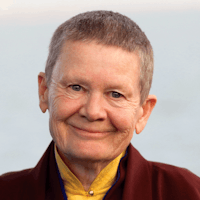
Pema Chödrön
Theme: Meditation
About This Pema Chödrön Quotation [Commentary]
Pema Chödrön places meditation in ordinary life. She begins with “the body that we have, the mind that we have, the domestic situation that we have, the job that we have, and the people who are in our lives.” Then she moves to “how we react to all these things,” and to “our emotions and thoughts just as they are right now, in this very moment, in this very room, on this very seat.” The practice is not elsewhere. It begins with what is here and with seeing it clearly.
She is also careful to say what this seeing is not. It is “not trying to make them go away, not trying to become better than we are.” That line keeps meditation from becoming another form of self-rejection. Pema Chödrön brings the attention back to what is actually happening: the thoughts, the emotions, the reactions that arise in daily life. Precision, in this passage, is the willingness to see what is there without turning away from it or reshaping it into something more flattering.
Yet this clarity is joined to “gentleness.” Pema Chödrön does not ask us only to see; she asks us to see “with precision and gentleness.” The two belong together. Precision keeps us honest about what is present, and gentleness keeps that honesty from becoming harshness. In that way, meditation becomes a steady way of meeting ourselves, our lives, and the people around us—just as they are, just as we are.
Additional Pema Chödrön Quotations
Related Quotes
Copyright © 2017 – 2026 LuminaryQuotes.com About Us