

You should develop your human nature to the point that you experience resonance even with a cluster of wild flowers, as if you were sharing a heartfelt conversation with them… That is a shortcut to restoring humanity to God.

You should develop your human nature to the point that you experience resonance even with a cluster of wild flowers, as if you were sharing a heartfelt conversation with them… That is a shortcut to restoring humanity to God.
Sun Myung Moon

A Gift for Us
Topic: The Natural World
God created us as His counterparts in love, and He prepared the natural world as a gift for us, His children. God would not leave His children in a barren desert devoid of any relief. That is why people have the duty to to preserve and love the natural world as God does. I am saying that you should develop your human nature to the point that you experience resonance even with a cluster of wild flowers, as if you were sharing a heartfelt conversation with them. This is as it was originally meant to be. That is a shortcut to restoring humanity to God.
Sun Myung Moon (born January 6, 1920, in Jeongju, in what is now North Korea – died September 3, 2012, in Gapyeong, South Korea) was a Korean religious leader, entrepreneur, and founder of the Unification movement. Raised in a rural Confucian-Christian household during the Japanese occupation of Korea, Moon’s early life was shaped by hardship, devotion, and a strong sense of spiritual calling. As a teenager, he experienced a profound vision in which he believed Jesus commissioned him to complete the work of restoring humanity to unity with God. This revelation became the foundation of his lifelong ministry, devoted to the ideal of universal peace and the healing of the relationship between the divine and human families.
In 1954, after enduring persecution and periods of imprisonment under both Japanese and communist authorities, Moon founded the Holy Spirit Association for the Unification of World Christianity in Seoul. His teachings—later presented systematically in the Exposition of the Divine Principle—offered a reinterpretation of Christian theology emphasizing God’s parental love, human responsibility, and the sanctity of marriage and family. Central to his vision was the belief that love is the creative force of the universe and that humanity’s purpose is to build a world reflecting the oneness of God’s heart. Through international missions, interfaith dialogue, and mass wedding ceremonies symbolizing global reconciliation, Moon sought to transcend divisions of race, religion, and nationality.
Beyond his religious work, Moon established numerous organizations in education, media, culture, and humanitarian service, aiming to foster dialogue, moral renewal, and peace. He and his wife, Hak Ja Han Moon, were regarded by followers as the “True Parents,” embodying the ideal of restored unity between men and women, heaven and earth. While his movement inspired both devoted commitment and significant controversy, Moon’s influence on global religion, culture, and peace initiatives remains substantial. His life reflected an unwavering pursuit of the vision of one human family under God—a vision he advanced with conviction, discipline, and enduring faith in the transformative power of divine love.
Cheon Seong Gyeong
Moon, Sun Myung, and Hak Ja Han Moon. Cheon Seong Gyeong. Seonghwa Chulpansa, 2015, p. 1401 [Sun Myung Moon, Cheon Seong Gyeong, Book 13, Chapter 2, Section 2.30].
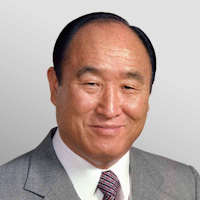
Sun Myung Moon
Theme: Natural World
Becoming a True Owner
Richard Rohr on Theosis
The Orthodox doctrine of theosis, according to John Paul II, is perhaps the greatest gift of the Eastern Church to the West, but one that has largely been ignored or even denied. The Eastern fathers of the Church believed that we could experience real and transformative union with God. This is in fact the supreme goal of human life and the very meaning of salvation—not only later, but now and later. Theosis refers to the shared deification or divinization of creation, particularly with the human soul where it can happen consciously and lovingly.
St. Gregory of Nazianzus (330-390) emphasized that deification does not mean we become God, but that we do objectively participate in God’s nature. We are created to share in the life-flow of Trinity. Salvation isn’t about replacing our human nature with a fully divine nature but growing within our very earthiness and embodiedness to live more and more in the ways of love and grace so that it comes “naturally” to us and is our deepest nature…
This is how a few ancients and contemporaries understand theosis:
Resources
Related Quotes
Copyright © 2017 – 2026 LuminaryQuotes.com About Us