

Be grateful for your life, every detail of it, and your face will come to shine like a sun, and everyone who sees it will be made glad and peaceful.

Be grateful for your life, every detail of it, and your face will come to shine like a sun, and everyone who sees it will be made glad and peaceful.
Jalaluddin Mevlana Rumi

Glad and Peaceful
Theme: Gratefulness
Be grateful for your life, every detail of it, and your face will come to shine like a sun, and everyone who sees it will be made glad and peaceful. Persist in gratitude, and you will slowly become one with the Sun of Love, and Love will shine through you its all-healing joy.
Jalāl al-Dīn Muḥammad Rūmī (born September 30, 1207, in Balkh, present-day Afghanistan – died December 17, 1273, in Konya, present-day Turkey) is revered as one of the world’s greatest poets, mystics, and spiritual teachers. Known in the West simply as Rumi, he was born into a family of scholars and mystics who fled westward during the Mongol invasions, eventually settling in Konya, then part of the Seljuk Empire. Under the guidance of his father, Bahāʾ al-Dīn Walad, Rumi was trained in Islamic theology, jurisprudence, and the contemplative disciplines of the Sufi path. His early years reflected the classical model of a scholar-saint—rooted in devotion, study, and service to his community.
Rumi’s life was transformed by his meeting with the wandering mystic Shams of Tabriz around 1244. Their profound spiritual companionship awakened in Rumi a passion that transcended formal learning and opened him to the depths of divine love. When Shams mysteriously disappeared, Rumi’s grief became the flame that illuminated his poetry and devotion. From this crucible emerged the Mathnawī, often called the “Persian Qur’an,” a six-volume masterpiece that weaves stories, parables, and reflections into a vision of love as the animating force of all creation. His shorter lyric poems, collected in the Divan-e Shams-e Tabrizi, sing of longing, union, loss, and the ecstatic dance between the soul and the Beloved.
Rumi’s teachings centered on the transforming power of divine love, the unity underlying all faiths, and the inward journey from self-centeredness to God-centeredness. He taught that every experience—joy and sorrow, presence and absence—serves as a mirror reflecting the divine mystery. After his passing, his followers established the Mevlevi Order, known for its sacred whirling as a form of remembrance (dhikr). Across eight centuries, Rumi’s voice has transcended language, culture, and creed, inviting seekers into the stillness of the heart where the human and divine meet in love.
The Discourses
Harvey, Andrew, and Hanut, Eryk (Phot.)―Rūmī Jalāl al-Dīn. Light upon Light: Inspirations from Rumi. North Atlantic Books, 1996. Step 3: Grateful Heart, Joyful Heart. [Jalāl al-Dīn Rūmī, The Discourses].
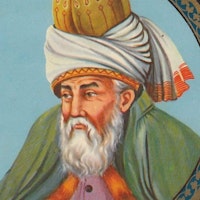
Jalaluddin Mevlana Rumi
Theme: Gratefulness
About This Jalāl al-Dīn Muḥammad Rūmī Quotation [Commentary]
Jalāl al-Dīn Muḥammad Rūmī begins with an encompassing invitation: “Be grateful for your life, every detail of it.” The words “every detail” extend gratitude beyond what is pleasant or easily welcomed. Jalāl al-Dīn Muḥammad Rūmī then describes how this practice becomes visible: “your face will come to shine like a sun.” What begins inwardly can be reflected in the way a person meets the world and other people.
Jalāl al-Dīn Muḥammad Rūmī carries this change into relationship: “everyone who sees it will be made glad and peaceful.” Gratitude is not only a private spiritual practice. Its effects can pass from one person to another through the quality of one’s presence. The “shine” Jalāl al-Dīn Muḥmammad Rūmī describes is joined to gladness and peace, so that what is cultivated within can also be received by others.
The context passage deepens the teaching with the instruction, “Persist in gratitude.” Jalāl al-Dīn Muḥammad Rūmī emphasizes gradual change: “you will slowly become one with the Sun of Love.” The word “slowly” keeps the teaching grounded in continued practice. Its culmination is that “Love will shine through you its all-healing joy.” To be grateful for “every detail,” to persist, and to let Love shine through one’s life becomes a path toward gladness, peace, and healing joy.
About This Rendering
I verified this wording as appearing in Andrew Harvey’s Light Upon Light: Inspirations from Rumi, a collection “translated and adapted” by Harvey, published by North Atlantic Books in 1996; an independent citation identifies this passage on p. 149. The English wording is Harvey’s rendering of Jalāl al-Dīn Muḥammad Rūmī rather than a literal transcription of Jalāl al-Dīn Muḥammad Rūmī’s Persian.
Rumi by Hazrat Inayat Khan
Additional Rumi Quotes and Poems
Resources
Related Quotes
Copyright © 2017 – 2026 LuminaryQuotes.com About Us