

To me, the Beloved Community is a realistic vision of an achievable society, one in which problems and conflict exist, but are resolved peacefully and without bitterness.

To me, the Beloved Community is a realistic vision of an achievable society, one in which problems and conflict exist, but are resolved peacefully and without bitterness.
Coretta Scott King

The Beloved Community
Topic: Global Peace & Development
To me, the Beloved Community is a realistic vision of an achievable society, one in which problems and conflict exist, but are resolved peacefully and without bitterness. In the Beloved Community, caring and compassion drive political policies that support the worldwide elimination of poverty and hunger and all forms of bigotry and violence.
Coretta Scott King (née Scott) was born on April 27, 1927, in Heiberger, Alabama, United States, the third of four children to Obadiah Scott and Bernice McMurry Scott. Raised in the rural South during the Great Depression, she worked alongside her family to sustain their farm while pursuing an education her parents insisted was essential. Valedictorian of Lincoln Normal School, she attended Antioch College in Ohio on scholarship before transferring to the New England Conservatory of Music in Boston, where she earned a degree in voice and piano. It was there she met Martin Luther King Jr., and the two married on June 18, 1953. Moving to Montgomery, Alabama, she quickly found herself in the midst of the civil rights struggle, using her musical gifts in concerts that blended artistry with advocacy.
Following the assassination of her husband in 1968, Coretta Scott King assumed a visible leadership role in the ongoing fight for racial justice. She founded the Martin Luther King Jr. Center for Nonviolent Social Change in Atlanta, working to preserve his legacy and advance the principles of nonviolent activism. Her efforts were instrumental in the campaign to establish Martin Luther King Jr. Day as a U.S. federal holiday, signed into law in 1983. Beyond civil rights, she expanded her advocacy to include women’s rights, opposition to apartheid in South Africa, and support for LGBTQ rights. She maintained relationships with national leaders, including presidents and members of Congress, using her influence to address both domestic and global human rights issues.
In later years, Coretta Scott King continued to speak, write, and participate in movements for justice and peace worldwide. She was recognized with honors such as the Gandhi Peace Prize and induction into both the Alabama Women’s Hall of Fame and the National Women’s Hall of Fame. On January 30, 2006, she died in Rosarito, Baja California, Mexico, at the age of 78, from complications of ovarian cancer. She was the first African American to lie in state at the Georgia State Capitol, and she was buried beside her husband at the King Center. Throughout her life, she articulated a vision of the “Beloved Community,” where conflicts are resolved peacefully and justice forms the foundation for lasting harmony—a vision that continues to influence movements for equality today.
King, Coretta Scott. “To me, the Beloved Community is a realistic vision of an achievable society, one in which problems and conflict exist, but are resolved peacefully and without bitterness.” Facebook, post by Coretta Scott King, https://www.facebook.com/corettascottking/posts/to-me-the-beloved-community-is-a-realistic-vision-of-an-achievable-society-one-i/689076578230095/.
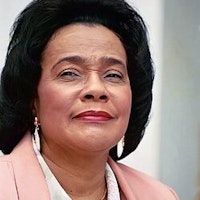
Coretta Scott King
Theme: Peace
About This Coretta Scott King Quotation [Commentary]
Coretta Scott King describes the Beloved Community as “a realistic vision of an achievable society,” rooted in what people and institutions can choose. She does not imagine a society without “problems and conflict.” Instead, she names conflict as part of life and points to the deeper task: that it can be “resolved peacefully and without bitterness.” Peace here is not avoidance or denial, but the practice of meeting difficulty without letting injury harden into resentment.
Coretta Scott King then widens the Beloved Community beyond personal conduct. In this community, “caring and compassion drive political policies,” so moral concern becomes public action. Her words move from resolving conflict to creating the conditions for human dignity: “the worldwide elimination of poverty and hunger and all forms of bigotry and violence.” Compassion is not only a private feeling; it is a force meant to shape decisions, laws, and shared responsibilities.
By calling the Beloved Community both “realistic” and “achievable,” Coretta Scott King gives this vision practical weight. The society she describes is not perfect, but it is committed to resolving conflict “without bitterness” and shaping policies through “caring and compassion.” Her words invite people and communities to help build conditions where poverty, hunger, bigotry, and violence are not accepted as inevitable. Peace becomes a living social practice: honest about conflict, rooted in compassion, and directed toward the well-being of all.
Additional Coretta Scott King Quotations
Resources
Related Quotes
Copyright © 2017 – 2026 LuminaryQuotes.com About Us