


The most beautiful experience one can have is the mysterious. It is the fundamental emotion that stands at the cradle of art and science.
Albert Einstein

The Most Beautiful Experience
Topic: Creativity, Culture, & the Arts
The most beautiful experience we can have is the mysterious. It is the fundamental emotion that stands at the cradle of true art and true science. Whoever does not know it and can no longer wonder, no longer marvel, is as good as dead, and his eyes are dimmed. It was the experience of mystery―even if mixed with fear―that engendered religion. A knowledge of the existence of something we cannot penetrate, our perceptions of the profoundest reason and the most radiant beauty, which only in their most primitive forms are accessible to our minds: it is this knowledge and this emotion that constitute true religiosity. In this sense, and only this sense, I am a deeply religious man… I am satisfied with the mystery of life’s eternity and with a knowledge, a sense, of the marvelous structure of existence―as well as the humble attempt to understand even a tiny portion of the Reason that manifests itself in nature.
Albert Einstein, born on 14 March 1879 and passing away on 18 April 1955, stands as one of the most renowned theoretical physicists in history. Best known for his groundbreaking special and general theories of relativity, his scientific endeavors spanned a multitude of areas within the field of physics. Amongst his numerous accolades, he was awarded the Nobel Prize in physics for his elucidation of the photoelectric effect—a phenomenon that expanded the horizons of quantum theory.
Einstein's journey, however, wasn't merely defined by scientific discoveries, but by the myriad challenges he overcame across various dimensions of his life. In his spiritual journey, he grappled with the concepts of God and universe. Socially, he navigated the complexities of his time—facing the rise of anti-Semitism, experiencing exile from his homeland due to Nazi oppression, and advocating for civil rights, disarmament, and global peace. These adversities only strengthened his resolve and underscored his resilience.
Beyond his professional accomplishments, Einstein's life was enriched by a tapestry of relationships and dialogues with luminaries from diverse fields. He engaged in profound conversations on the nature of reality with the likes of the Indian poet Rabindranath Tagore, discussed the principles of non-violence with Mohandas Gandhi, and deliberated on humanitarian issues with Albert Schweitzer. Furthermore, his camaraderie with fellow scientists and physicists provided a fertile ground for intellectual exchanges, fostering an environment of collaboration and innovation during one of the most exciting epochs in scientific history.
The World as I See It
Wilson, Andrew, editor. World Scripture II. Universal Peace Federation, 2011, p. 166 [Einstein, Albert, and Alan Harris. The World as I See It. Philosophical Library, 1949] pp. 24 - 28.
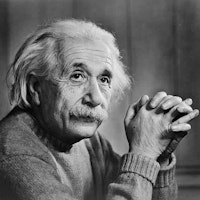
Albert Einstein
Theme: Beauty
About This Albert Einstein Quotation [Commentary]
Albert Einstein begins with wonder: “The most beautiful experience we can have is the mysterious.” He calls it “the fundamental emotion that stands at the cradle of true art and true science.” Art and science both arise from meeting what exceeds our understanding. “The existence of something we cannot penetrate” awakens imagination, attention, and the desire to know, drawing us toward “the marvelous structure of existence.”
Albert Einstein then writes, “Whoever does not know it and can no longer wonder, no longer marvel, is as good as dead, and his eyes are dimmed.” To wonder is to remain open to “the profoundest reason and the most radiant beauty,” though these are accessible to our minds only “in their most primitive forms.” Human knowledge is limited, but this limitation can deepen humility. His statement that “imagination is more important than knowledge” belongs to the same understanding: imagination remains open to what knowledge has not yet reached.
From this experience, Albert Einstein turns to what he calls “true religiosity.” It is “a knowledge, a sense, of the marvelous structure of existence” and of the “Reason that manifests itself in nature.” He is “satisfied with the mystery of life’s eternity,” while making “the humble attempt to understand even a tiny portion” of it. Beauty here is joined with humility: people of every gender may encounter the order and radiance of existence without claiming to master it, allowing the mysterious to guide their efforts to understand and create.
Additional Albert Einstein Quotes
Resources
Related Quotes
Copyright © 2017 – 2026 LuminaryQuotes.com About Us