

Let nothing upset you; Let nothing frighten you. Everything is changing; God alone is changeless. Patience attains the goal. Who has God lacks nothing; God alone fills every need.

Who has God lacks nothing; God alone fills every need.
Saint Teresa of Avila

Let Nothing Upset You
Topic: Belief & Faith
Let nothing upset you;
Let nothing frighten you.
Everything is changing;
God alone is changeless.
Patience attains the goal.
Who has God lacks nothing;
God alone fills every need.
Teresa of Avila, born Teresa Sánchez de Cepeda Dávila y Ahumada on March 28, 1515, in either Ávila or Gotarrendura, Spain, was a Carmelite nun, mystic, and religious reformer. Raised in a devout Catholic household, she was drawn to the lives of the saints and developed an early sense of spiritual longing. After her mother died when she was fourteen, she deepened her devotion, eventually entering the Carmelite Convent of the Incarnation at age twenty. There, amid periods of illness and inner conflict, she began to experience contemplative prayer and moments of religious ecstasy, shaped by her reading and desire for deeper union with God.
As Teresa’s interior life matured, she became concerned with the state of her religious community. She sought to renew the Carmelite Order by encouraging a return to simplicity, silence, and devotion. Together with Saint John of the Cross, she helped found the Discalced Carmelites, emphasizing a more focused, prayer-centered life. Though her reforms faced resistance, they gradually gained support and papal recognition. Despite poor health, Teresa traveled across Spain to establish new convents, grounding each one in her vision of contemplative discipline and spiritual integrity.
Teresa of Avila is also known for her writings, which explore the life of prayer and the soul’s movement toward God. In The Life of Teresa of Jesus, The Way of Perfection, and The Interior Castle, she shared her experiences with clarity and depth, offering practical guidance for those drawn to contemplative practice. Her language is direct, shaped by personal insight rather than theory. She died on October 4, 1582, in Alba de Tormes. Canonized in 1622 and named a Doctor of the Church in 1970, Teresa’s influence continues through her writings, her reform work, and the spiritual communities she helped form.
Wehlage, James, trans. for God Makes The Rivers to Flow. ["Let Nothing Upset You," Saint Teresa of Avila].
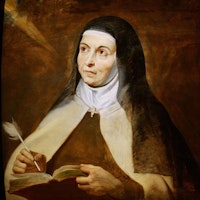
Saint Teresa of Avila
Theme: Belief and Faith
About This Saint Teresa of Avila Quotation [Commentary]
Teresa of Avila begins with the heart in ordinary unrest: “Let nothing upset you; / Let nothing frighten you.” She does not deny fear or instability. She names life as it is: “Everything is changing.” Then she places beside that change the one reality that does not pass: “God alone is changeless.” Her counsel is a steady return to God when circumstances shift.
Teresa of Avila then gives the inner practice this trust requires: “Patience attains the goal.” Patience grows from knowing that “Everything is changing” while “God alone is changeless.” Belief and Faith are formed through endurance, not only through certainty or ease. Her words teach the soul to remain with God through delay, loss, and uncertainty, instead of being ruled by what “upset[s]” or “frighten[s]” us.
The final lines gather the whole passage: “Who has God lacks nothing; / God alone fills every need.” Teresa of Avila is not saying that human beings have no sorrow, limitation, or daily needs. She is pointing to the soul’s deepest need, where “God alone fills” what nothing else can fill. To have God is not to stand empty at the center: “Who has God lacks nothing.”
Commentary About Saint Teresa of Avila by Eknath Easwaran
Saint Teresa of Avila (1515-1582) is a much-loved Catholic saint and mystic from Avila, Spain, who followed both the way of action and the way of contemplation. This little poem “Let Nothing Upset You” was written without thought of publication and was found in her breviary after her death.
Teresa de Cepeda y Ahumada, later to become loved around the world as St. Teresa of Jesus, grew up as a beautiful, high-spirited girl from one of the most distinguished families in the sixteenth-century Spanish town of Avila. With charm, intelligence, keen artistic sensibilities, and a saving dose of common sense, she seemed to have the world at her feet. Yet while still in her teens, this passionate young woman had already begun to find the attractions of worldly life too small to satisfy her. She felt their pull – would be torn in two by it, in fact, for more than twenty years. But nothing could silence a much deeper appeal, a call to a far higher destiny.
Some dim awareness of an infinite promise deep within her must have prompted her to turn inward. In her writings, Teresa describes candidly what was taking place inside. “All the things of God gave me great pleasure,” she recalls, “but I was held captive by the things of this world.” Yet the inward pull would not let her go:
Young Teresa had seen what life offers on the surface, and it was not enough. She longed for much greater challenges, deeper awareness, something more lasting than this world of change. “There is no joy in the finite,” the Upanishads say. “There is joy only in the Infinite.” Teresa’s soul yearned for the Infinite, and nothing less would satisfy her.
Teresa of Avila is so appealing a figure, so human and yet so inspiring, that we naturally want to know her secret. What enabled her to turn herself inward, heart and soul? Is it something that we can follow?
As it happens, Teresa did leave us her “secret.” In her autobiography, she stresses over and over the one quality she found vital: determinación, determination, decision, will. “Those who have this determination,” she declares, “have nothing to fear.”
Determination? Is that all? Surely, we think, some loftier, finer qualities must come before this mundane one. But then we reflect on our own experience. In any walk of life—arts, sciences, sports, entertainment—wherever excellence is achieved, there is one quality we almost always find: the sheer will to overreach oneself, to keep going whatever the odds until the goal is attained. St. Teresa is simply reminding us that we need this same quality to reach an infinite goal. The same determination with which we pursue passing, personal satisfactions can be used for spiritual growth.
If we find that we are not making the kind of progress we would like on the spiritual path, Teresa is suggesting, the reason may be simply that we are not trying our hardest. We may have all kinds of other reasons, but often the problem is simple lack of determination.
—Eknath Easwaran [Blue Mountain Blog, Deepening Determination, Advice From Saint Teresa (November 18, 2014)].
Additional Saint Teresa Quotes (Passages for Meditation)
Resources
Related Quotes
Copyright © 2017 – 2026 LuminaryQuotes.com About Us