


The soul exists independent of the body, and continues after the body dies, taking up a new spiritual body.
Saint Thomas Aquinas

The Soul Exists
Topic: Immanence & Transcendence
The soul exists independent of the body, and continues after the body dies, taking up a new spiritual body.
Saint Thomas Aquinas (born circa 1225 in Roccasecca, Italy – died March 7, 1274, at the Abbey of Fossanova) is one of the most influential theologians and philosophers in Christian history. Born into a noble family near Naples, Thomas was educated first at the Benedictine Abbey of Monte Cassino, where his intellectual promise was recognized early. Against his family’s wishes, he later joined the Dominican Order, choosing a life of poverty, study, and preaching over the political and ecclesiastical prospects reserved for him. This decisive act of freedom and devotion marked his lifelong search for truth—a pursuit grounded in the conviction that faith and reason are harmonious paths to the same divine source.
Thomas studied under Saint Albert the Great in Cologne and Paris, where he developed a disciplined method of inquiry that sought coherence between theology and philosophy. Drawing deeply from the works of Aristotle, he reinterpreted classical thought within a Christian framework, arguing that creation’s rational order reflects the mind and goodness of God. His monumental Summa Theologica stands as a synthesis of Christian doctrine and philosophical reflection, exploring questions of existence, morality, virtue, and divine purpose. He taught that reason can guide the human mind toward understanding God’s creation, yet revelation is necessary for receiving the fullness of divine truth.
Known for his humility and serenity of mind as much as for his intellectual brilliance, Thomas approached theology as an act of worship—an offering of the intellect to God. His writings shaped the development of Western theology, ethics, natural law, and education for centuries. Canonized in 1323 and later named a Doctor of the Church, he is honored for his luminous vision of the relationship between faith and reason and for his conviction that love is the highest form of wisdom. Saint Thomas Aquinas’s legacy endures as a witness to the unity of intellect and devotion, reminding seekers that the pursuit of truth, when guided by humility and love, becomes a path toward the divine.
Croissant, Kay, and Catherine Dees. Continuum, the Immortality Principle: Based on an Exhibit Presenting Human Speculations on the Possibility of Continuing Consciousness, First Shown at the California Museum of Science and Industry. Croissant, 1978, p. 23 [Saint Thomas Aquinas].
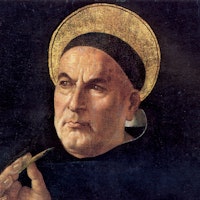
Saint Thomas Aquinas
Theme: Our Soul
Copyright © 2017 – 2026 LuminaryQuotes.com About Us
Saint Thomas Aquinas (c. 1225 – 7 March 1274)
Saint Thomas Aquinas (c. 1225 – 7 March 1274) was an Italian Catholic philosopher and theologian in the scholastic tradition, known as Doctor Angelicus, Doctor Universalis. He is the most famous classical proponent of natural theology. He gave birth to the Thomistic school of thought (Thomism), which has long been the primary philosophical and theological approach of the Catholic Church.
Saint Thomas Aquinas lived at a critical juncture of western culture when the arrival of the Aristotelian corpus in Latin translation reopened the question of the relation between faith and reason, calling into question the modus vivendi that had obtained for centuries. This crisis flared up just as universities were being founded. Thomas, after early studies at Montecassino, moved on to the University of Naples, where he met members of the new Dominican Order. It was at Naples too that Thomas had his first extended contact with the new learning. When he joined the Dominican Order he went north to study with Albertus Magnus, author of a paraphrase of the Aristotelian corpus. Thomas completed his studies at the University of Paris, which had been formed out of the monastic schools on the Left Bank and the cathedral school at Notre Dame. In two stints as a regent master Thomas defended the mendicant orders and, of greater historical importance, countered both the Averroistic interpretations of Aristotle and the Franciscan tendency to reject Greek philosophy. The result was a new modus vivendi between faith and philosophy which survived until the rise of the new physics. The Catholic Church has over the centuries regularly and consistently reaffirmed the central importance of Thomas’s work, both theological and philosophical, for understanding its teachings concerning the Christian revelation, and his close textual commentaries on Aristotle represent a cultural resource which is now receiving increased recognition.
―Saint Thomas Aquinas [Stanford Encyclopedia of Philosophy, revised May 23, 2014].
Jacques Maritain
Additional St. Thomas Aquinas Quotes