


This is holy ground, all evidence to the contrary. It’s hard to believe… you realize that death is as sacred as birth.
Anne Lamott

As Sacred As Birth
Topic: Life Beyond Death & the Spirit World
Grief and friends, time and tears will heal you to some extent. Tears will bathe and baptize and hydrate and moisturize you and the ground on which you walk. Do you know the first thing that God says to Moses? He says, ‘Take off your shoes.’ Because this is holy ground, all evidence to the contrary. It’s hard to believe, like my tiny personal self, you realize that death is as sacred as birth. And don’t worry. Get on with your life. Almost every single death is easy and gentle with the very best people surrounding you for as long as you need. You won’t be alone. They’ll help you cross over to whatever awaits us.
Anne Lamott, born April 10, 1954, in San Francisco, California, United States, is an American novelist, nonfiction writer, essayist, and memoirist known for blending sharp humor with honest reflections on faith and everyday struggle. Her books draw on her own life, including experiences with alcoholism, single motherhood, depression, and a candid, sometimes irreverent Christianity. Based in Marin County, California, Anne Lamott is also a progressive political activist, public speaker, and writing teacher whose work has reached readers well beyond the literary world.
Anne Lamott grew up in a literary household; her father, Kenneth Lamott, was a writer, and her mother, Dorothy Lamott, was an attorney. She attended Drew School in San Francisco and later studied at Goucher College in Maryland, where she wrote for the college newspaper before returning to California. Her first published novel, Hard Laughter (1980), written for her father after his brain cancer diagnosis, set the pattern for much of her work: unsentimental, often funny, and rooted in the real pressures of family and illness. In the decades that followed, she published both fiction and nonfiction, including Operating Instructions: A Journal of My Son’s First Year, Bird by Bird: Some Instructions on Writing and Life, Traveling Mercies: Some Thoughts on Faith, Help, Thanks, Wow, and Dusk, Night, Dawn, where she continues to explore writing, spirituality, and the practice of hope.
Anne Lamott’s public life has unfolded alongside her writing. Her career and teaching were profiled in the 1999 documentary Bird by Bird with Annie: A Film Portrait of Writer Anne Lamott. She received a Guggenheim Fellowship in 1985 and was inducted into the California Hall of Fame in 2010. She has contributed essays to Salon and other outlets and has described books as “medicine” that tell the truth about “human hearts, spiritual transformation, families, secrets, wonder, craziness—and that can make me laugh.” In her personal life, she has one son, Sam (born 1989), a grandson, Jax (born 2009), and, in April 2019, she married writer Neal Allen. Through this mix of family story, spiritual searching, and steady, often humorous candor, Anne Lamott has become a trusted voice for readers learning to live honestly with both their wounds and their faith.
Lamott, Anne. Almost Everything: Notes on Hope. Riverhead Books, 2018, p. 152.
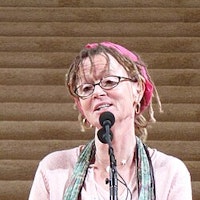
Anne Lamott
Theme: Life Beyond Death
About This Anne Lamott Quotation [Commentary]
Anne Lamott begins with the plain truth that when those we “cannot live without die,” we do not simply “get over these losses,” nor are we “supposed to.” Grief may be “a lifelong nightmare of homesickness,” yet the person may “live again fully” in the heart if we do not “seal it off.” In this sense, Life Beyond Death is not treated first as an idea, but as love continuing through absence, memory, tears, and the cracks where “the light gets in.”
Anne Lamott then turns to the body’s honest response to loss: “Grief and friends, time and tears will heal you to some extent.” She does not say tears will remove sorrow, but that they will “bathe and baptize and hydrate and moisturize you and the ground on which you walk.” This prepares the heart for her central recognition: “Take off your shoes,” because “this is holy ground, all evidence to the contrary.” Even where grief feels unbearable, Anne Lamott asks us to notice that the ground beneath us may still be sacred.
From there, Anne Lamott speaks with simple courage: “It’s hard to believe, but it’s the truest thing I know.” With age and tenderness, she says, “you realize that death is as sacred as birth.” This does not erase the ache of parting, but it changes the frame around it. Death becomes not only an ending, but a crossing in which “you won’t be alone,” with “the very best people surrounding you for as long as you need.” Her final reassurance is grounded and humane: “Don’t worry—get on with your life,” trusting that, as we approach “whatever awaits us,” we are helped, accompanied, and “walking each other home.”
Anne Lamott’s 12 Truths: #10, #11, and #12 [Excerpt from extended context passage]
Number 10 — Grace
Grace is spiritual WD-40, or water wings. The mystery of grace is that God loves Henry Kissinger and Vladimir Putin and me exactly as much as He or She loves your new grandchild. Go figure.
The movement of grace is what changes us, heals us and heals our world. To summon grace, say, “Help,” and then buckle up. Grace finds you exactly where you are, but it doesn’t leave you where it found you. And grace won’t look like Casper the Friendly Ghost, regrettably. But the phone will ring or the mail will come and then against all odds, you’ll get your sense of humor about yourself back. Laughter really is carbonated holiness. It helps us breathe again and again and gives us back to ourselves, and this gives us faith in life and each other. And remember — grace always bats last.
Number 11 — God
God just means goodness. It’s really not all that scary. It means the divine or a loving, animating intelligence, or, as we learned from the great “Deteriorata,” “the cosmic muffin.” A good name for God is: “Not me.” Emerson said that the happiest person on Earth is the one who learns from nature the lessons of worship. So go outside a lot and look up. My pastor said you can trap bees on the bottom of mason jars without lids because they don’t look up, so they just walk around bitterly bumping into the glass walls. Go outside. Look up. Secret of life.
Number 12 — Death
And finally: death. Number 12. Wow and yikes. It’s so hard to bear when the few people you cannot live without die. You’ll never get over these losses, and no matter what the culture says, you’re not supposed to. We Christians like to think of death as a major change of address, but in any case, the person will live again fully in your heart if you don’t seal it off. Like Leonard Cohen said, “There are cracks in everything, and that’s how the light gets in.” And that’s how we feel our people again fully alive.
Also, the people will make you laugh out loud at the most inconvenient times, and that’s the great good news. But their absence will also be a lifelong nightmare of homesickness for you. Grief and friends, time and tears will heal you to some extent. Tears will bathe and baptize and hydrate and moisturize you and the ground on which you walk.
Do you know the first thing that God says to Moses? He says, “Take off your shoes.” Because this is holy ground, all evidence to the contrary. It’s hard to believe, but it’s the truest thing I know. When you’re a little bit older, like my tiny personal self, you realize that death is as sacred as birth. And don’t worry — get on with your life. Almost every single death is easy and gentle with the very best people surrounding you for as long as you need. You won’t be alone. They’ll help you cross over to whatever awaits us. As Ram Dass said, “When all is said and done, we’re really just all walking each other home.”
I think that’s it, but if I think of anything else, I’ll let you know.
Resources
Related Quotes
Copyright © 2017 – 2026 LuminaryQuotes.com About Us